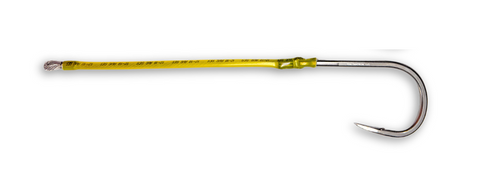
Trolling Hooks 101: Stickiness, Gap & What Actually Matters
Picking the right hook is one of those details that separates a lure that swims great in the water from a lure that actually converts strikes into hookups. Get the hook wrong and you're leaving fish in the water no matter how good the shape or the skirt looks. Here's what actually goes into that decision.
For our size-by-size hook recommendations, check out our Hook Sizing Guide. This article digs into the why behind those numbers.
Hook Sizing & the Concept of "Stickiness"
Hook sizing runs on a numbered scale — that's true across the board. But not every hook style shares the same range, and the number doesn't mean the same thing from one hook type to the next.
Trolling hooks — the trailer hook and stiff rig style hooks used for marlin and tuna — are typically sized somewhere in the 7/0 to 12/0 range.
Japanese double fang hooks have their own separate sizing system entirely, and that sizing isn't standardized — it varies by brand. A given number on one manufacturer's Japanese double doesn't necessarily match the same number from another.
As hook size increases within a given style, so does the gauge of steel used to make it. A smaller hook is made from thinner steel, which means less resistance when the hook needs to punch through a fish's jaw or bill. That translates directly into what serious anglers call a hook's "stickiness" — its ability to penetrate and stay lodged in the fish.
Stickiness isn't determined by gauge alone. Several factors stack together:
- Point/cut of the tip — how the point is ground and shaped affects how easily it penetrates
- Barb — size and design affects both initial penetration and holding power once set
- Strength — how much force the hook can take before it fails
- Gauge — the thickness of the steel itself
- Hook size — 1/0 through 12/0, affecting both penetration and holding power
- Failure mode — whether a hook bends or breaks under extreme load
Ringed Eye vs. Needle Eye
Hooks also differ in eye construction, and the two types serve distinct purposes.
Ringed eye hooks are the common, standard hook type — a closed loop eye. These are used for trailer hook rigs, where a second hook needs to follow behind the first in sequence.
Needle eye hooks have a straight, narrow eye built to be run directly through with wire cable rather than tied. These are used exclusively for stiff rigs — the needle eye lets the cable pass straight through and get crimped in place, creating that solid, rigid single-hook setup used for billfish.
[ PHOTO: Ringed eye vs. needle eye, close-up, side by side ]
The Gap Tradeoff
Hook size doesn't just scale steel gauge — it also scales the gap, the space between the shank and the point of the hook.
The bigger the hook, the bigger the gap — and the bigger the gap, the more likely a fish's jaw actually lands inside that space when it strikes, increasing the chance of a solid hookup. That's the case for sizing up.
But smaller hooks carry thinner gauge steel, which increases stickiness — the ease with which the point penetrates on contact. So you've got two competing effects working in opposite directions as hook size changes: a bigger gap improves your odds of the hook landing in the right spot, while a smaller gauge improves your odds of that hook actually setting once it's there.
How a fish attacks the lure matters just as much as the hook itself. The "right" hook size isn't a fixed answer — it's a balance between gap, gauge, and the strike behavior of what you're actually targeting.
[ PHOTO: Gap comparison between two hook sizes — priority shot ]
How Different Fish Strike
Marlin tend to chase a lure down and strike at it with their bill before eating it — an attack, not a straight swallow. That bill-strike is why hook placement matters so much: the hook can end up stuck directly in the bill, or slide down toward the corner of the mouth, depending on how the hook is positioned in the rig.
Ahi (tuna), by contrast, tend to simply swallow the lure whole — no bill strike to account for.
Matching Rig Style to Species
Stiff rigs — a single needle-eye hook mounted rigidly on wire cable, coated in shrink tubing — are the widely accepted standard for targeting billfish, matching the way marlin strike and get hooked in the bill or corner of the mouth.
Trailer hook rigs, using ringed-eye hooks with a second hook riding behind the first, are typically the choice for ahi fishing — matching the way tuna swallow a lure whole. Trailer rigs are also commonly run for mahi mahi and ono.
[ PHOTO: Assembled stiff rig and assembled trailer rig, side by side — priority shot ]
Safety note: If mahi mahi are in your target species, be careful. Mahi are notoriously wild and unpredictable at boatside — leadering and gaffing them can turn into a thrashing mess in seconds. That second hook, dangling free on a trailer rig, is one of the most common ways anglers actually get a hook lodged in themselves. Treat that free hook with respect the moment the fish is close.
Hook Craftsmanship & Failure Modes
Not all hooks are created equal, even within the same size and style.
Craftsmanship issues to watch for:
- The bend in the eye — a poorly finished eye can leave a sharp edge, which is one more reason chafe tubing at the leader connection isn't optional
- Barb cut and point sharpness — conical vs. beveled edge finishing affects performance. Some fishermen sharpen or alter hooks by hand to get the point and edge exactly how they want it
Temper and failure mode: The temper of the hook — how hard the steel is — determines how it fails under real load. Push a hook hard enough, and it will either bend open or break/snap off completely.
Most experienced anglers favor hooks that bend under extreme stress over hooks that break. It's not that a bent hook usually stays attached — more often than not, the fish still gets off. But a bent hook at least leaves a slight chance the connection holds. A broken hook removes that chance entirely.
That said, no hook is immune to breaking — not even the best, most trusted hooks on the market. There's a physical weak point at the bend in every hook; it's simple physics. Certain circumstances put unusual stress on exactly that weak point — a marlin hooked in the bill in just the wrong way can load tension onto a portion of the hook it was never really tested against. When that happens, even a premium, well-made hook can fail. Rigging well and choosing quality gear improves your odds — it doesn't guarantee anything.
Corrosion & Why Translucent Shrink Tubing Matters
Even hooks marketed as rust-resistant will eventually show signs of corrosion. It's not usually obvious on the exposed shank — more often it shows up as small rust spots or pitting hidden under shrink tubing connectors, where saltwater gets trapped even after a proper washdown.
[ PHOTO: Corrosion/pitting hidden under shrink tubing ]
This is why many anglers prefer translucent shrink tubing over solid colors at the hook connection. Being able to visually check the hook and connection underneath — without cutting anything apart — lets you catch corrosion or hidden damage before it becomes a problem mid-fight.
[ PHOTO: Translucent vs. solid shrink tubing ]
Hook Brands
Every angler ends up with brand preferences, usually earned the hard way through years on the water.
Right now, the three names that come up most in trolling circles are Mustad, Fudo, and Tantrum — each with its own strengths and tradeoffs, and no single one is objectively "best" across the board. Which one a given captain reaches for often comes down to personal experience and what they've had success with in the past.
[ PHOTO: Hook brand comparison — Mustad / Fudo / Tantrum side by side ]